Owls, hawks, falcons, and even a roadrunner!
San Diego is home to dozens of raptor species. Meet our bird ambassadors and discover the awe-inspiring qualities of each species.

American Barn Owl
Tyto furcata
American Barn Owls are ghostly pale and active at night. They have a whitish face, chest, and belly. During the day, they rest in quiet places, but at night, they hunt in open fields and meadows. You can hear their eerie, raspy calls, which are different from the hoot of other owls.
Burrowing Owl
Athene cunicularia
Burrowing Owls are unique birds that hunt on the ground during the day. They are small, sandy-colored, with bright-yellow eyes, and live in underground burrows. These burrows can be self-dug or taken from prairie dogs, ground squirrels, or tortoises. They thrive in grasslands, deserts, and other open areas, hunting insects and rodents. Our local San Diego population is threatened due to habitat loss and degradation. That’s why we’re working in a multi-agency collaborative partnership with San Diego Zoo Wildlife Alliance on a dedicated recovery program for western burrowing owls. Our participation supports the conservation breeding goals of the program. Owl groups produced from conservation breeding are soft-released as an effort to support the establishment of the first recovery node for burrowing owls in San Diego County.


Crested Caracara
Caracara plancus
The Crested Caracara, a striking bird with a sharp beak and talons, has the look of a hawk but acts like a vulture. It’s a large tropical black-and-white falcon, easily recognized by its tall stance, long yellow-orange legs, and sharp black cap against a white neck and yellow-orange face. Found in open country in just a few southern U.S. states, it flies low on flat wings and often walks on the ground. Known in Central and South American folklore as the ‘Mexican eagle,’ the Crested Caracara is a bird rich in legend.
Ferruginous Hawk
Buteo regalis
The Ferruginous hawk can be found in prairies, deserts, and the open range of the West. They hunt from trees, rock outcrops, or high in the sky. The typical adult is pale, with reddish shoulders and thigh feathers, a whitish tail with red toward the tip. They have a wide head, long wings that are broad at the base and taper toward the tip, and wings that form a shallow V while soaring. Ferruginous Hawks eat a diet of small mammals, sometimes standing above prairie dog or ground squirrel burrows to wait for prey to emerge.


Great Horned Owl
Bubo virginianus
The Great Horned Owl, with its long, earlike tufts and piercing yellow eyes, is the classic owl from storybooks. This powerful bird can hunt prey larger than itself, including other raptors, but also eats small creatures like mice, frogs, and scorpions. Found across North America in deserts, wetlands, forests, grasslands, backyards, and cities, it’s one of the most common and adaptable owls. Its deep hooting voice and fierce hunting skills make it a remarkable predator in various habitats.
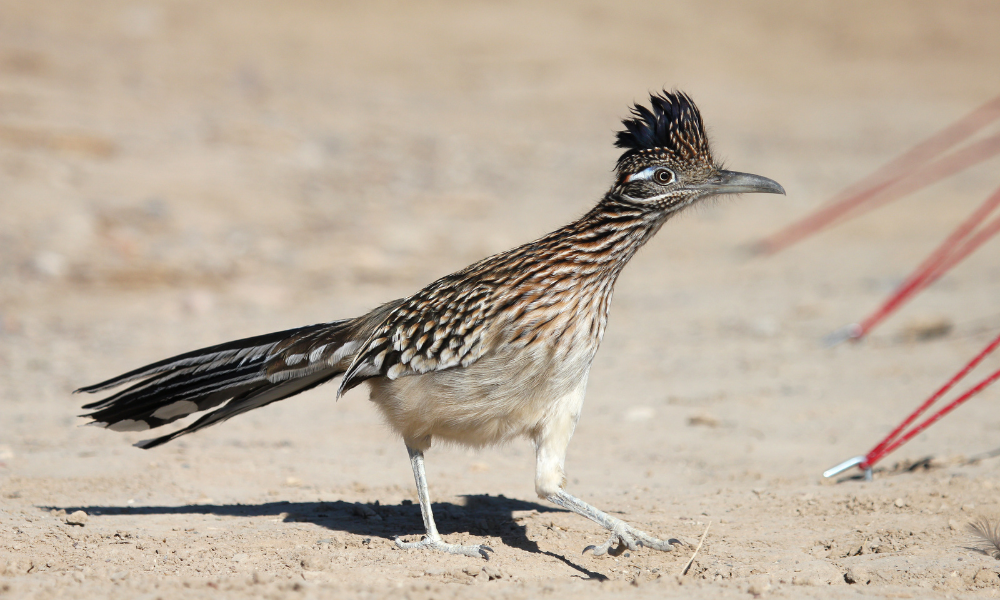
Greater Roadrunner
Geococcyx californianus
The Greater Roadrunner, a remarkable bird, thrives in the Desert Southwest. It can outrun humans, kill rattlesnakes, and has a blue-black crest with mottled feathers. Roadrunners use their long tails as rudders and run with their bodies parallel to the ground. Despite the ‘beep, beep’ cartoon, real roadrunners face threats from faster coyotes, which can run up to 43 mph!

Harris’s Hawk
Parabuteo unicinctus
Harris’s Hawk is a standout with bold markings of dark brown, chestnut red, and white; long yellow legs; and yellow markings on its face. The most social of North American raptors, these birds hunt in teams. When hunting, a group of hawks surrounds their prey, flush it for another to catch, or take turns chasing it.
Long-eared Owl
Asio otus
Long-eared Owls have slim bodies, upright ear tufts, and excellent camouflage for night hunting. They fly silently with fringed feathers and hunt with sharp hearing. Listen for their hoots and barking calls in spring and summer nights.


Mitred Conure
Psittacara mitratus
The snappy green-and-red mitred conure is a very active, comical, and eager-to-explore bird. They typically live in dry subtropical zones, as well as in some forests and grassy hills, and are found naturally in Peru, Bolivia, and Argentina. They were introduced to California, Hawaii, and Florida, where they are usually seen in pairs or in large groups of up to 100. There are many theories on how conures ended up in San Diego. It’s most likely that the flocks we see today are a result of wild-caught birds that were either accidentally or intentionally released in our area.
Red-tailed Hawk
Buteo jamaicensis
The Red-tailed Hawk is one of the most common hawks in North America. They soar over fields with their broad wings or sit on telephone poles, looking for prey. Their raspy scream is famous and often used in movies to depict the sound of a hawk or eagle. These hawks are known for their reddish-brown tails, which help them stand out. Red-tailed Hawks are also adaptable and can live in various environments, from deserts to forests. They play a crucial role in controlling rodent populations, making them essential for the ecosystem.


Turkey Vulture
Cathartes aura
Turkey vultures are large, dark birds with long, broad wings. They are bigger than raptors (except eagles and condors). They appear Black from a distance, but up close, they are a dark brown with a featherless red head and pale bill. While most of their body and forewings are dark, the undersides of the flight feathers are paler, giving a two-toned appearance. The Turkey Vulture forages by smell, an ability that is uncommon in the avian world. They often fly low to the ground to pick up the scent of carrion. Their olfactory lobe, responsible for processing smells, is huge compared to that of other animals.
Swainsons Hawk
Buteo swainsoni
Swainson’s Hawks, native to the Great Plains and the West, glide on narrow wings and perch on fence posts. They hunt rodents in flight and chase insects on the ground. Each fall, they migrate to Argentina, forming huge flocks with Turkey Vultures and Broad-winged Hawks. Bird watchers gather in the southern U.S., Mexico, and Central America to witness these migrations.

If you find an injured bird or animal, please visit Project Wildlife’s Wildlife Help Hub.
Since 1972, Project Wildlife’s dedicated staff and volunteers have given injured, orphaned, and sick wild animals a second chance at life. This commitment to helping wild animals has grown tremendously and Project Wildlife is now one of the largest wildlife rehabilitation organizations in the country. Our mission is to improve the quality of life for local wildlife and the community, serving as the primary resource for wild animal rehabilitation in San Diego County.